

Few names in all of sports carry as much weight as Hank Aaron. His journey from humble beginnings in Mobile, Alabama, to becoming one of the greatest baseball players of all time is a testament to talent, resilience, and unshakable determination. Born in 1934, Aaron grew up in a segregated South, dreaming of a future beyond the limitations imposed on Black athletes at the time. With a relentless drive to succeed, he honed his skills in local sandlots before catching the attention of professional scouts.
Aaron’s greatest moment came on April 8, 1974, when he did what many thought was impossible—he broke Babe Ruth’s legendary home run record of 714. Amid intense pressure and even racist threats leading up to the milestone, Aaron remained composed. With one powerful swing, he sent his 715th home run over the fence, cementing his place in history.
23 years and one-week later on April 17, 1997. Hank Aaron would be in Mobile throwing out the first pitch for the first ever Mobile Bay Bears game, at the opening of the stadium that bears his name; Hank Aaron Stadium. Hank Aaron Stadium, affectionately known as “The Hank,” was more than just a ballpark—it was a symbol of Mobile, Alabama’s deep-rooted connection to baseball. Besides Hank, the Port City was the birthplace to five Pro Baseball Hall of Famers, more than any other city besides Los Angeles and New York.
For over two decades, the Mobile BayBears called Hank Aaron Stadium home. Competing in the Southern League, the BayBears produced numerous players who would go on to shine in MLB. Among the notable alumni were Justin Upton, Jason Bay, Jake Peavy, and Max Scherzer, all of whom left their mark on the sport. The BayBears also secured four Southern League Championships and five Division Championships, proving their dominance in the league.
One of the most celebrated events in the stadium’s history was the 1999 Double-A All-Star Game, held on July 14, 1999. The game featured a showdown between National League-affiliated All-Stars and American League-affiliated All-Stars, with the National League team emerging victorious, 3–0, in front of a crowd of 6,174 fans. The largest crowd in Hank Aaron Stadium history.

Despite its rich history, Hank Aaron Stadium faced challenges in its later years. Attendance steadily declined, with the stadium averaging only 1,700 fans per game, the lowest in the Southern League. Issues such as inadequate drainage, outdated facilities, and poor field lighting contributed to the stadium’s struggles. The decline of Hank Aaron Stadium is a painful sight for many who remember its glory days. The facility was built in 1997 for around $8.5 million, a fraction of what other cities were spending on minor league ballparks at the time. Around the early 2000’s the trend in minor league baseball was to have the concourses elevated so you wouldn’t miss a pitch. The Hank’s concourse was located under the grandstand, which ended up being outdated by the 2000’s. In a move to preserve Hank Aaron’s legacy, his childhood home, which had been transformed into a museum on the stadium property, was relocated to another site in Mobile in 2021.
While it served its purpose for years, its location—far from Mobile’s waterfront and downtown—made it difficult to sustain strong attendance. By the late 2010s, the writing was on the wall, and the BayBears relocated to Madison, Alabama, becoming the Rocket City Trash Pandas.

Today, Hank Aaron Stadium now sits abandoned along I-65, a shadow of its former self. Today, the stadium sits for sale, with its fate hanging in the balance. Former BayBears general manager Chris Morgan has expressed concerns that whoever buys the land will likely demolish the stadium, as maintaining it would be costly. The city’s lease with the property owners has also been called into question, with legal complications preventing Mobile from having a direct say in the stadium’s future.
While some fans still stop by to pay tribute to Hank Aaron, the deteriorating condition of the stadium has led many to wonder whether Mobile will ever properly honor its hometown hero again. Some have suggested repurposing the site for community events or even preserving elements of the stadium as a historical landmark. However, without a clear plan, The Hank may soon become just another memory.
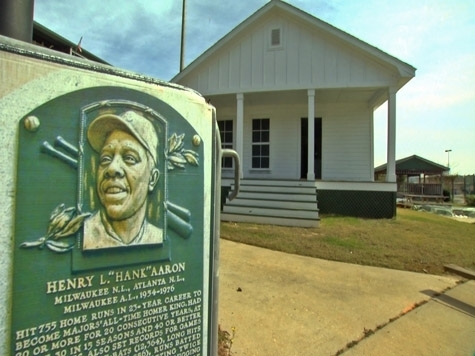
Regardless of what happens to the stadium, Hank Aaron’s legacy remains untouchable. His childhood home, which was relocated to the grounds of the stadium years ago, is expected to be preserved no matter what. Whether Mobile finds a way to honor Aaron with a new facility or lets the stadium fade into history, his impact on baseball and sports history will never be forgotten.
For now, The Hank sits quietly empty, in limbo, waiting for it’s next chapter — possible demolition.


About The Author
