
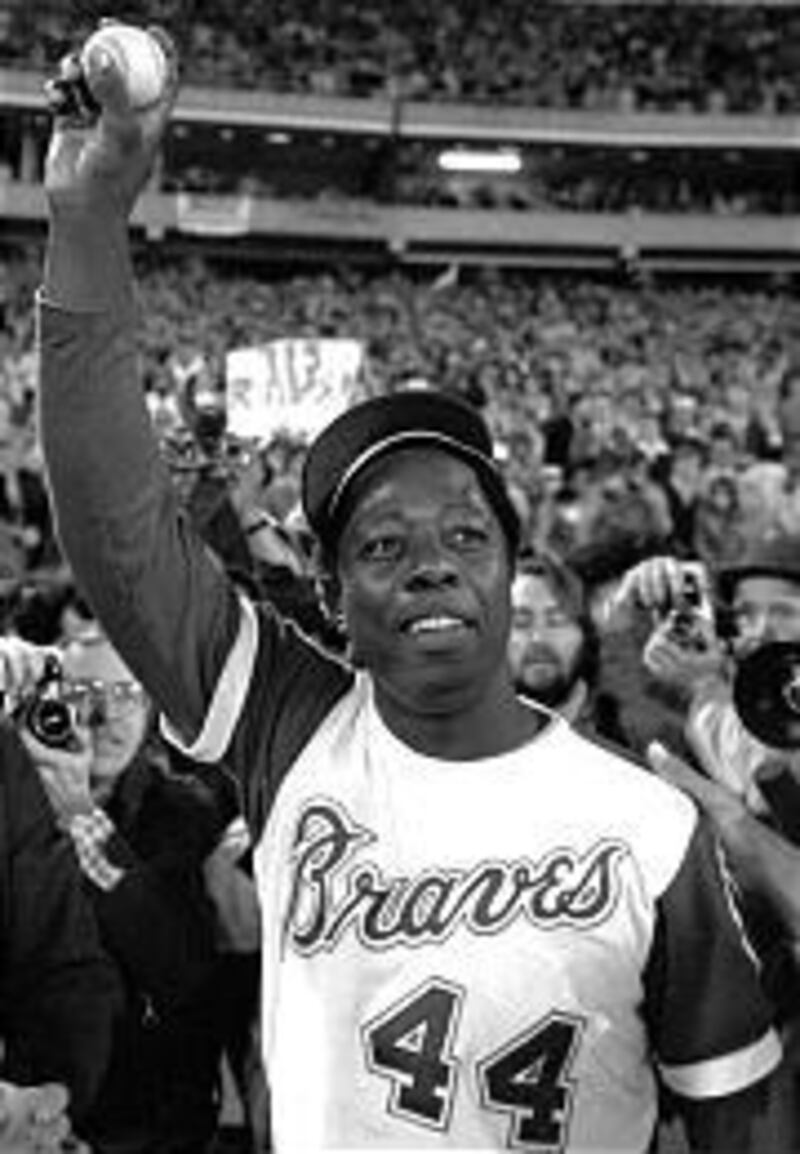
On April 8, 1974, the world witnessed a moment that would forever be etched in the annals of baseball history. As Mobile’s own Hank Aaron stepped up to the plate at Atlanta-Fulton County Stadium and shattered one of the most revered records in sports. With a swing of his bat, Aaron hit his 715th career home run, surpassing Babe Ruth’s long-standing record of 714 home runs and becoming Major League Baseball’s new home run king.
Facing Los Angeles Dodgers pitcher Al Downing, Aaron sent the second pitch of his fourth-inning at-bat soaring over the left-centerfield wall. The crowd of nearly 54,000 fans erupted in celebration as Aaron rounded the bases, greeted by teammates and fans alike. The significance of Aaron’s achievement went beyond the numbers. His home run symbolized perseverance, breaking barriers in a sport—and a country—marked by deep racial divisions.

(Dodgers pitcher Al Downing gets ready to pitch to Hank Aaron, moments before the home run)
Facing Los Angeles Dodgers pitcher Al Downing, Aaron sent the second pitch of his fourth-inning at-bat soaring over the left-centerfield wall. The crowd of nearly 54,000 fans erupted in celebration as Aaron rounded the bases, greeted by teammates and fans alike.
Aaron’s journey to this historic achievement was far from easy. As he approached Ruth’s record, Aaron endured intense scrutiny, receiving thousands of letters—many of them filled with racist threats and vitriol. Despite the immense pressure, Aaron remained focused and determined, letting his performance on the field speak for itself.
(Above: Hank Aaron trotting around the bases while fans rushed the field in celebration at Atlanta’s Fulton County Stadium.)
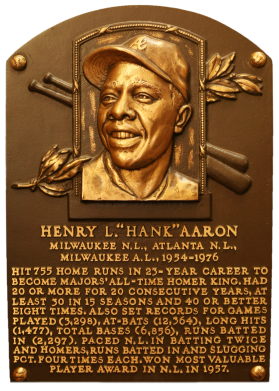
Hank Aaron’s career spanned 23 seasons, during which he amassed an incredible 755 home runs, a record that stood until 2007. Beyond his power at the plate, Aaron was a model of consistency, finishing his career with a .305 batting average, 3,771 hits, and 2,297 RBIs—the latter two still ranking among the highest in MLB history.
Aaron’s impact extended far beyond baseball. He was a trailblazer who broke barriers and inspired generations, earning accolades such as the Presidential Medal of Freedom in 2002. His legacy as a player, humanitarian, and advocate for equality continues to resonate.
Hank Aaron’s career spanned 23 seasons, during which he amassed an incredible 755 home runs, a record that stood until 2007. Beyond his power at the plate, Aaron was a model of consistency, finishing his career with a .305 batting average, 3,771 hits, and 2,297 RBIs—the latter two still ranking among the highest in MLB history. He finished a career as a 23 time all-star and was inducted in the Hall of Fame in 1982
Aaron’s impact extended far beyond baseball. He was a trailblazer who broke barriers and inspired generations, earning accolades such as the Presidential Medal of Freedom in 2002. His legacy as a player, humanitarian, and advocate for equality continues to resonate.
(President George W. Bush presenting the Presidential Medal of Freedom in 2002 to Hank Aaron.)
Fifty-one years later, Hank Aaron’s achievement remains a defining moment in sports history. As Mobile’s favorite son, Aaron’s legacy is a source of pride for his hometown and a testament to the power of perseverance and excellence. Today, we celebrate not just the home run that made history but the man who embodied greatness on and off the field.

About The Author
