
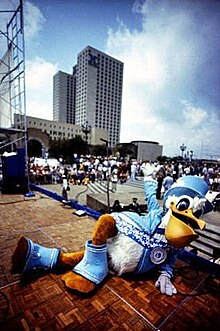
This week, we’re taking Mascot Monday in a different direction — back to 1984, when New Orleans played host to the Louisiana World Exposition,also known as the World’s Fair. The grounds sat right along the Mississippi River in what is now the Ernest N. Morial Convention Center and the Riverwalk area. From May-November 1984, over 7.5 million from all over the world flocked to New Orleans to experience the World’s Fair, which coincidentally wasn’t considered very successful. It marked the last time the Fair would be held in the United States, but nonetheless remains an important part of New Orleans’ history, and locals still speak favorably of the Expo over 40 years later.

While walking around by the Mississippi River in New Orleans this past weekend, I spotted reminders of that era — the King statue at the entrance to Mardi Gras World, relics tucked around the Riverwalk, and even the remains of the old gondola system and the façade of the historic Nesbit’s Market in the Warehouse District. All of it sparked a memory of one of the fair’s most whimsical creations: its pelican mascot, Seymore D’Faire

Seymore D’Faire wasn’t just a cartoon mascot — he was a full-fledged ambassador for the 1984 Louisiana World Exposition, embodying the state’s charm, humor, and hospitality. As Louisiana’s beloved state bird, he cut an unforgettable figure: a white-feathered bird with a solar-power orange beak and talons, blue-and-black eyes framed by cheek tufts, and dressed in elegant finery. His baby-blue tuxedo jacket, matching top hat adorned with feathers, white gloves, and spats gave him a dignified southern aristocratic flair, while accessories blue umbrella and pipe added a whimsical touch and homage to New Orleans’ famous second line parades.
Before he became “Seymore,” he was simply known as “Mr. Pelican,” created in June 1983 without an official name. That changed after a citywide naming contest organized with a local store chain, which drew over 18,000 entries. The winning submission came from Susan Shambra, a computer operator, whose clever “Seymore D. Fair” played on the local “Yat” dialect — meaning “see more of the fair” — while tying into the event’s Cajun flair.
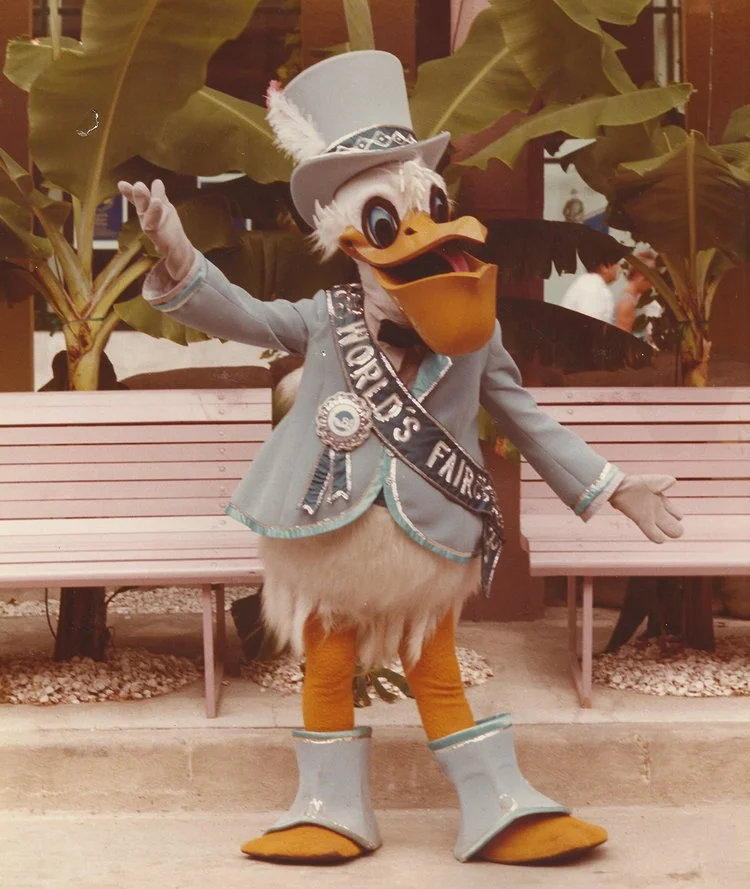
From that moment on, Seymore took flight as the face of the World’s Fair. He was everywhere in 1984: greeting guests at the gates, posing for photos with children, plastered across posters, banners, buttons, and merchandise. Alongside his trusty sidekick, Pepé la Gator, he entertained more than 7 million visitors from around the world, guiding them through pavilions celebrating food, music, technology, and culture.
Seymore’s role wasn’t confined to New Orleans. He toured the globe, promoting the World’s Fair from Los Angeles to New York to Paris and London. His adventures became legendary — being escorted out of the Louvre in France for being “too spectacular,” sharing the stage with Vice President George H. W. Bush during the 1984 Republican National Convention, and hanging out with Billy Joel at the White House while entertaining the wives of Russian diplomats. He even made a cameo on “Saturday Night Live,” filmed guarding a White House entrance alongside Secret Service agents.

Though the 1984 World’s Fair faced financial struggles, Seymore emerged as one of its most enduring symbols. His influence extended beyond the exposition itself. In the years that followed, he championed educational and community initiatives, promoting substance-free lifestyles, animal welfare, and positive behavior programs. A highlight came in 1986, when he joined First Lady Nancy Reagan at the “Just Say No” Rally in the Louisiana Superdome.
Seymore’s legacy lives on through the Seymore Foundation, established in 2015 to support preadolescent drug awareness, education, and prevention, as well as various community programs and law enforcement initiatives. His magical and whimsical personality — part Southern gentleman, part globe-trotting showman — has made him one of the most recognizable world’s fair mascots of the modern age, earning honors and recognition on the local, state, national, and international levels.
Today, decades later, his image still resurfaces in vintage memorabilia shops, collectors’ circles, and the fond memories of locals who recall when New Orleans tried to “show the world” its best. Standing among the remnants by the river — the gondola towers, the pavilions, and the faded echoes of music — you can almost imagine Seymore still out there, wings open wide, tipping his baby-blue hat, and inviting everyone to see more of the Crescent City.



About The Author
