

Former college pitcher, trusted radio producer and longtime high school football host Lance Tolbert spent his life keeping Mississippi connected to its games, and to one another.
Every Friday night in the Fall, after the final whistle blew. Somewhere in Mississippi, Lance Tolbert went to work.
While coaches gathered their teams near midfield, parents waited outside locker rooms, and fans slowly made their way toward the parking lot, Tolbert was settling into another familiar routine. Phones rang. Scores poured in from every corner of the state. One by one, he helped bring another Friday night to life for listeners across Mississippi.
For countless fans, hearing Lance Tolbert on the Mississippi Farm Bureau High School Scoreboard Show was simply part of football season. It didn’t matter whether your hometown won by 40 points or lost a heartbreaker in overtime. Somewhere along the way home, there was a good chance you turned on SuperTalk Mississippi hoping to hear your school’s score, your coach’s interview, or your star player’s name mentioned on statewide radio.
That was Lance’s gift.
He understood that high school football in Mississippi wasn’t just about the biggest schools or the future SEC stars. It was about communities. It was about the dozens of small Mississippi towns where Friday nights still revolve around the local football stadium.
This week, Mississippi lost one of the people who helped tell those stories.
Lance Tolbert, longtime producer, broadcaster and one of the most recognizable voices on SuperTalk Mississippi, passed away at just 51 years old. His loss is felt throughout Mississippi, not simply because of the jobs he held, but because of the relationships he built over decades in sports and broadcasting.
To thousands of Mississippians, Tolbert wasn’t just the producer and co-host of Mornings with Richard Cross, he was part of their morning routine.
Whether the conversation centered on politics, the latest SEC headlines, recruiting news or the previous night’s ballgames, Tolbert and Richard Cross developed an easy chemistry that made listeners feel like they were riding along with two friends on the drive to work. Every weekday morning, they helped wake up Mississippi, blending news, sports and conversation into one of the state’s most recognizable radio programs.
Cross was the show’s primary host, but Tolbert became much more than the producer sitting behind the console. He jumped into conversations naturally, delivered timely information, added perspective when it mattered and kept the program moving. Listeners came to know his voice almost as well as Cross’s.
The show works because each understood the other.
One drove the conversation.
The other knew exactly when to add to it.
It is a role most listeners never truly appreciate until it is suddenly missing.
But before Lance Tolbert became a familiar voice on Mississippi radio, he was known for something entirely different.
He was a star pitcher.
Growing up in Brandon, Tolbert developed into one of Mississippi’s top baseball prospects at Northwest Rankin High School, graduating in 1993. Standing well over six feet tall with a strong right arm, he earned a scholarship to Auburn.
As a freshman in 1994, Tolbert joined an Auburn program that advanced all the way to the College World Series in Omaha. For any college baseball player, reaching Omaha represents the pinnacle of the sport, and Tolbert experienced it before most players ever have the chance.
His journey, however, wasn’t always straightforward.
After Auburn, Tolbert transferred first to UAB before eventually returning home to Mississippi to continue his career at Ole Miss.
Transfers have become commonplace in today’s college athletics, but during the 1990s they often meant sitting out an entire season before becoming eligible again. Tolbert waited his turn, continued working, and eventually earned his opportunity with the Rebels.
When he finally took the mound in Oxford, he quickly became one of the most dependable pitchers on the staff. The 1997 Ole Miss baseball team wasn’t loaded with championships or postseason glory, but Tolbert gave the Rebels consistency. He finished the season leading the team in both victories and earned run average, becoming the reliable veteran every club hopes to have.
The following spring, head coach Pat Harrison handed Tolbert the baseball on Opening Day. He wasn’t necessarily the hardest thrower to wear an Ole Miss uniform, nor would his name appear on lists of the greatest Rebel pitchers of all time.
But teammates knew something else. When Lance Tolbert took the mound, he competed, and t hat competitive spirit followed him long after his playing days ended.
Many athletes struggle once the cheering stops. Tolbert found another way to stay connected to sports. Instead of throwing fastballs, he began telling the stories.
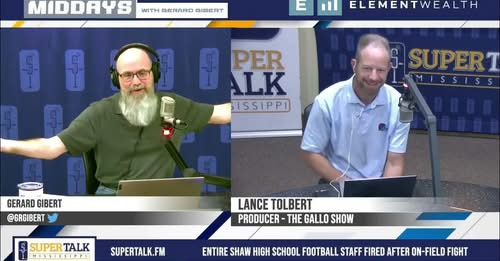
From the Mound to the Microphone
Longtime Ole Miss broadcaster Gary Darby first met Tolbert during Ole Miss baseball broadcasts in the late 1990s, when Tolbert was the Rebels’ pitcher. Their friendship continued for nearly three decades. They traveled together, coached together and eventually worked together after Tolbert proposed creating a program devoted to Ole Miss baseball. For several years, the two co-hosted The Rebel Strike Zone on Saturday mornings.
It was a natural progression for someone who understood baseball from inside the game. Tolbert knew that pitching was more than velocity. He understood sequencing, failure, adjustments and the uneasy solitude that comes with standing on a mound while everyone waits for the next pitch.
Those experiences gave weight to his analysis. He had not merely watched college baseball. He had pitched in the SEC. He had been part of a College World Series team. He had started on Opening Day at Swayze Field.
Yet his career never fit neatly into one category.
Tolbert worked in politics on Capitol Hill and served as a statewide campaign field representative. He raised funds for Ole Miss and helped direct sales, marketing and finance for “The Majesty of Spain,” the landmark cultural exhibition held in Jackson in 2000.
He later spent 14 years in financial services as a wealth manager, broker and vice president. He held a real estate license and managed hotels and hospitality properties in Oxford.
Then, in 2010, he joined SuperTalk Mississippi Media.
He initially worked with SuperTalk North Mississippi in Oxford before relocating to the company’s Jackson headquarters. Over the next 16 years, he became one of the network’s most versatile contributors.
Tolbert produced Mornings with Richard Cross, The Garden Mama Show, The Handyman Show and the Mary Wieden & You Show. His responsibilities required far more than pushing buttons or watching a clock.
Tolbert was especially good at it because his mind never seemed to stop working.
Mary Wieden recalled that Tolbert could locate a fact “lickety-split.” She also remembered the smaller acts that revealed the man beyond the console, including the time he bought her a pair of earbuds when her headset became uncomfortable and refused to accept repayment.
During football season, his workload could be staggering. He might begin with a morning show at 5 a.m., return for the statewide high school football broadcast at 10 p.m. Friday and then be back at work Saturday morning.
Wieden summarized his value plainly.
“It’ll take about three people to replace him,” she said. “He did so much.”

The Voice of the Scoreboard
Tolbert’s most visible role came on Friday nights in the Fall.
High school football in Mississippi is not simply entertainment. It is community identity compressed into four quarters. In some towns, the stadium is the brightest place for miles. Generations of families sit in the same sections. Children lean against fences hoping to slap hands with players. Restaurants stay open later. Gas stations fill with buses and pickup trucks.
And when the final horn sounds, people want to know what happened everywhere else.
Who won the rivalry game?
Which ranked team was upset?
Who scored four touchdowns?
Who clinched a division championship?
Which small-town program just produced the greatest victory in its history?
Tolbert gave Mississippi those answers.
He moved from score to score and county to county, turning dozens of individual games into one statewide conversation. A listener traveling home from a road game in North Mississippi could hear what happened on the Gulf Coast. A coach in the Pine Belt could discuss his team’s victory with fans in the Delta.
Tolbert understood that each score represented more than numbers. Behind every final was a senior playing one of his last games. A first-year coach earning a breakthrough victory. A quarterback becoming a hometown hero. A community celebrating together. He treated those stories with the seriousness they deserved.
That may be Tolbert’s greatest contribution to Mississippi sports.
He made local games feel important because he knew they were important.
The Final Sign-Off
Lance Tolbert’s final outing came far too soon.
At just 51 years old, he still had countless stories left to tell.
Football season is only weeks away. Before long, stadium lights will pierce the Mississippi sky, marching bands will echo through small towns, and another season of unforgettable Friday nights will begin. The games will go on, just as they always have.
But they’ll sound different.
On Friday nights, Mississippi fans driving home from the stadium won’t hear the familiar voice that spent years tying together the stories from every corner of the state, one final score, one coach’s interview and one hometown celebration at a time.
And when the alarm clocks go off Monday morning, thousands of Mississippians will climb into their trucks, start the drive to work and tune in to Mornings with Richard Cross. For years, Lance Tolbert was part of that routine. Whether the conversation was about politics, SEC football, the weather or whatever was making headlines that day, his voice became a familiar companion to commuters from the Delta to the Gulf Coast.
That voice is now silent.
Yet his impact will continue to echo across Mississippi.
It will live on in every small-town football program that felt seen because its score made the statewide broadcast. In every young broadcaster who learned that preparation matters. In every listener whose mornings were made a little brighter by the easy back-and-forth between Richard Cross and Lance Tolbert. And in every colleague who knew they could count on him when the red “On Air” light came on.
Lance Tolbert’s life took him from the pitcher’s mound at Auburn and Ole Miss to the radio studios of SuperTalk Mississippi. Along the way, he became much more than a former athlete or a broadcaster.
He became part of Mississippi’s daily rhythm.
For thousands of people, he helped start the day.
For thousands more, he helped put the finishing touches on Friday night.
Few people get to become part of a state’s soundtrack.
Lance Tolbert did.
And that is a legacy that will continue to be heard long after the microphone has gone silent.

About The Author
