

.When the first crisp winds of autumn begin to tease the Gulf Coast, the rumble of chrome, V-8s, and polished steel stirs something deep within the hearts of car lovers. Each October, along the sun-kissed ribbon of Highway 90, a spectacle unfolds: classic cars, hot rods, custom rides, and vintage icons unite in a rolling tribute to automotive history. What began as a modest Gulf Coast gathering has exploded into a coast-wide celebration.
For one week every October, the Gulf Coast transforms into one long, gleaming highway of nostalgia. Classic cars line Highway 90 from Bay St. Louis to Pascagoula in what has become known as America’s Largest Block Party — a coast-wide celebration of horsepower, craftsmanship, and community pride.
What started in 1996 as a local tourism experiment has become a full-fledged institution — a sporting event of its own kind, blending competition, pageantry, and Gulf Coast spirit.
A Humble Start: The 1996 Dream
The idea was simple but bold. In the mid-1990s, South Mississippi tourism leaders faced a problem familiar to beach towns everywhere: when the summer ended, so did the visitors.
A group of visionaries, including casino representatives, city officials, and local car enthusiasts, pitched a plan to bring people back after Labor Day — a car festival that would stretch across the Coast, inviting classic-car owners to “cruise the beach” and celebrate automotive history.
That first event, Cruisin’ the Coast 1996, saw just 374 registered vehicles. Still, those cars — and their drivers — laid the foundation for something extraordinary. They gathered in Biloxi, Gulfport, and Ocean Springs, showing off vintage Corvettes, Fords, Pontiacs, and Chevys beneath the palm trees.
Locals came out in droves, and organizers immediately knew they had tapped into something special. This wasn’t just a car show — it was a revival, a celebration of what makes the Mississippi Coast unique: the love of community, storytelling, and the open road.
Growing Momentum: A Coastwide Phenomenon

By the next year, registrations nearly tripled, topping 1,000 cars. Within a decade, the number passed 4,000. Even hurricanes couldn’t halt the momentum. After Hurricane Georges in 1998, the show went on. Following Hurricane Katrina in 2005, the event became a rallying point — a symbol of the Coast’s determination to rebuild, one block at a time.
Today, Cruisin’ the Coast attracts close to 10,000 registered cars and more than 100,000 visitors, spanning all 50 states and several foreign countries. It routinely earns national recognition, including multiple USA Today “10 Best” awards as the #1 Car Show in America.
The event now stretches across the entire Mississippi Gulf Coast, featuring official “cruise sites” in:
Bay St. Louis – Waveland – Pass Christian – Long Beach – Gulfport – Biloxi – D’Iberville – Ocean Springs – Gautier – Moss Point – Pascagoula.
Each stop is a festival in itself — live music, food vendors, burn-out competitions, and show-and-shine contests where proud owners polish chrome until it mirrors the clouds above.
Highway 90 as a Stadium
From a Magnolia Coast Sports perspective, Cruisin’ the Coast is as much a sporting event as any game on a field or track.
Every participant prepares for months — restoring engines, fine-tuning paint jobs, detailing interiors until they glisten like trophies. They arrive ready to compete, not necessarily for medals, but for admiration, conversation, and respect.
Each car is an athlete in its own right, conditioned through countless hours of training. Each lot becomes a locker room filled with proud owners, tools, and touch-up cloths.
Highway 90 serves as the stadium — a 60-mile asphalt arena where fans cheer from lawn chairs instead of bleachers. The “athletes” roll past in waves of nostalgia: Bel Airs, Mustangs, Road Runners, and Thunderbirds, each representing a different era of American muscle and style.
Cultural Impact: The Heartbeat of the Coast
Cruisin’ the Coast isn’t just an event — it’s an identity.
Locals mark their calendars a year in advance. Families set up tents, lawn chairs, and barbecue pits along the median. Restaurants plan menus around the rush.
Economically, it’s one of the most significant events in Mississippi. Studies have estimated that Cruisin’ the Coast injects tens of millions of dollars into the local economy each year. Hotels book out months in advance. Mechanics, gas stations, and body shops thrive. Even small-town mom-and-pop diners see record crowds.
The cultural effect, however, might be even greater. The event unites multiple cities and counties under one shared banner. It’s a symbol of resilience, too. After Katrina, the sight of those cars cruising through rebuilt roads became a cathartic moment. The sound of engines drowned out the silence left by disaster — a reminder that the Coast always rolls on.
Cruisin’ as Competition: The Spirit of Showcase
While Cruisin’ the Coast doesn’t have a “winner,” the spirit of friendly competition is everywhere. Car owners beam with pride when someone stops to compliment a restoration. Awards are handed out for best vintage, best custom, and best paint.
In Gulfport, at Cruise Central at Jones Park. Engines purr, judges walk the line, and spectators crown their favorites.
In Biloxi, the “Swap Meet” and “Autocross” events add layers of sport. Drivers test their handling skills in timed runs, showing that these machines aren’t just for looks — they were built to move.
Over in Pascagoula, the Beach Park site has become a late-week tradition, welcoming the final waves of cruisers as they make their way east. It’s the Coast’s victory lap — cars parked under the oaks, music echoing from the stage, and the Gulf breeze whispering through chrome grilles.
A Rolling Museum: The Cars That Define It
To walk the lots of Cruisin’ is to walk through time.
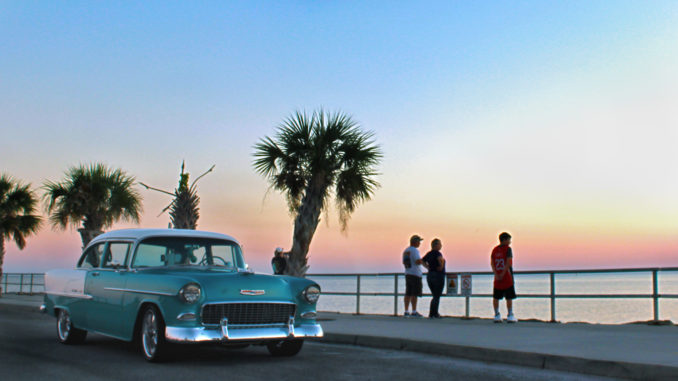
You’ll see 1950s Chevys lined up like pearls — gleaming, pastel reminders of the American dream. 1960s Mustangs flex their muscle, polished and poised like linebackers under stadium lights. 1930s Fords hum quietly beside modern Corvettes, bridging nearly a century of engineering evolution.
Each car carries a story. Some are family heirlooms. Others were rescued from barns and rebuilt from rust. A few have names — “Betsy,” “The Rebel,” or “Blue Belle” — whispered proudly by owners who’ve spent decades keeping them alive.
That’s what makes Cruisin’ special. It’s not corporate. It’s personal. Every car is someone’s masterpiece, every lot a gallery of passion and patience.
A Community in Motion
For local residents, Cruisin’ isn’t just a spectator event; it’s a chance to participate. Volunteers handle parking, stage setup, and logistics. Local musicians perform sets that range from Elvis tributes to beach rock. Nonprofits sell food and drinks, turning proceeds into community projects.
Even schools get involved — auto-tech students showcase restoration work, culinary programs cook for VIPs, and local bands provide live entertainment. It’s civic engagement on wheels.
And perhaps most importantly, Cruisin’ the Coast embodies what makes South Mississippi special: resilience, creativity, and camaraderie.

About The Author
